Mathematics
Level 1/Group Theory

4. Dihedral Group

-----
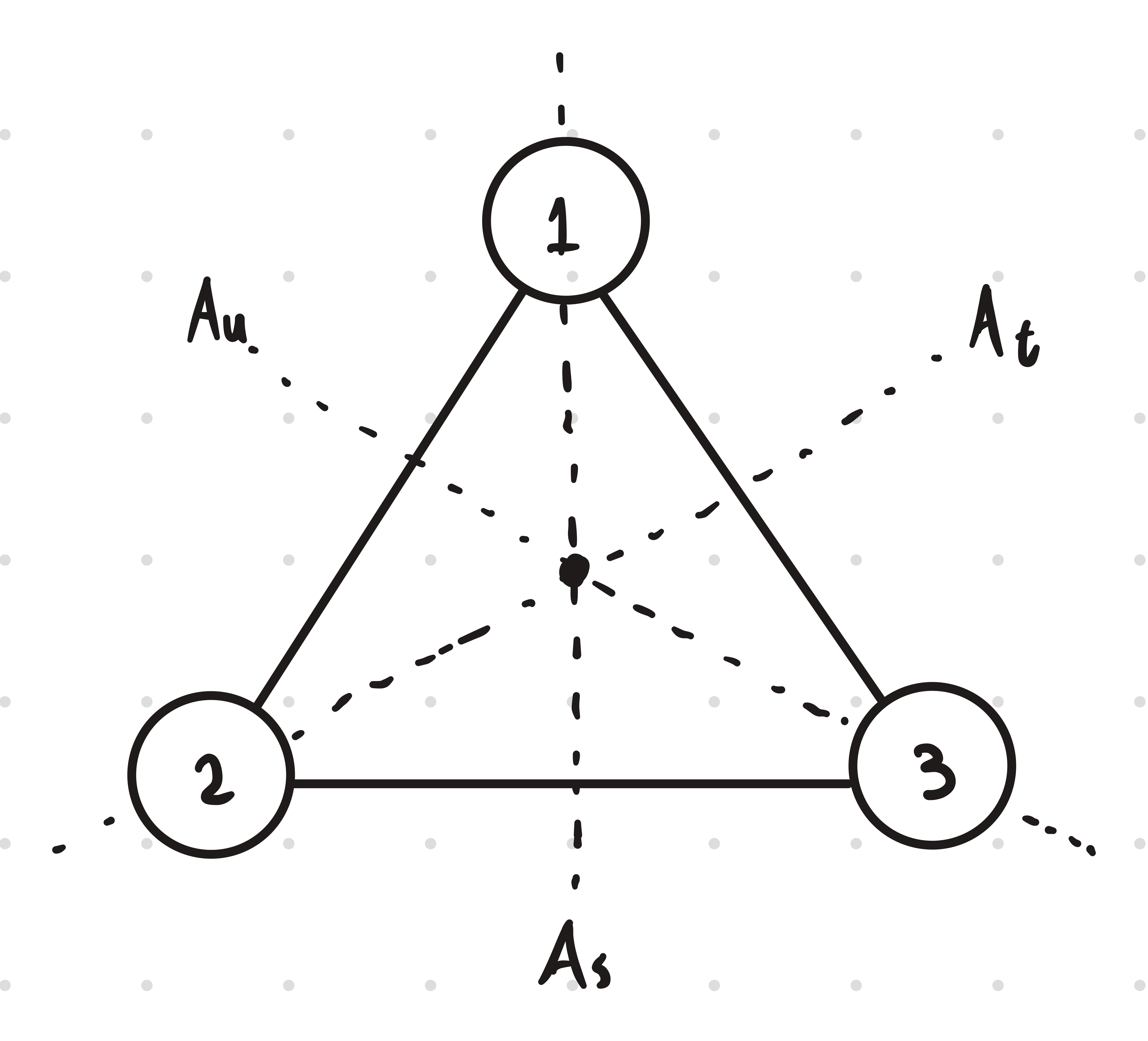
Equilateral triangle

Node Positions

6 unique combinations

(1,2,3)=Id,(3,1,2)=r,(2,3,1)=r2(1, 2, 3) = Id, \quad (3, 1, 2) = r, \quad (2, 3, 1) = r^2 (1,3,2)=s,(3,2,1)=t=rs,(2,1,3)=u=r2s(1, 3, 2) = s, \quad (3, 2, 1) = t = rs, \quad (2, 1, 3) = u = r^2s


Transformation Representation

We can now write all transformations in terms of rr and ss

{  Id,  r,  r2,  s,  rs,  r2s  }\{\; Id, \; r, \; r^2, \; s, \; rs, \; r^2s \; \}


Satisfies Composition Rules?


Closure

For any x,yG,x, y \in G, the product (xy)G(x \cdot y) \in G

(rs)(r2s)=r(sr2)s=r(rs)s=r2s2=r2(rs)(r^2s) = r(sr^2)s = r(rs)s = r^2s^2 = r^2


Associativity

For all elements in GG, (xy)z=x(yz)(x \cdot y) \cdot z = x \cdot (y \cdot z)

(rs)r2=r(sr2)(rs)r^2 = r(sr^2)


Identity

There exists an element eGe \in G such that ex=xe=xe \cdot x = x \cdot e = x for every xGx \in G

Idr=rId  Ids=sIdId \circ r = r \circ Id \\ \; \\ Id \circ s = s \circ Id


Inverse

For each xGx \in G, there exists an element x1Gx^{-1} \in G such that x1x=xx1=ex^{-1} \cdot x = x \cdot x^{-1} = e

(rs)(sr)=r(sr)s=r(r2s)s=r3s2=IdId=Id(rs)(sr) = r(sr)s = r(r^2s)s = r^3s^2 = Id \circ Id = Id


Summary

  • (D3D_3) is the dihedral group of order 6
  • It captures all rotations and reflections of an equilateral triangle
  • Every group axiom is satisfied, making it a proper mathematical group